
Registration Options
| Details | Price | Qty |
|---|---|---|
| Level 7 Diploma in High Voltage Electrical Systems | €0.00 (EUR) | Expired |
-
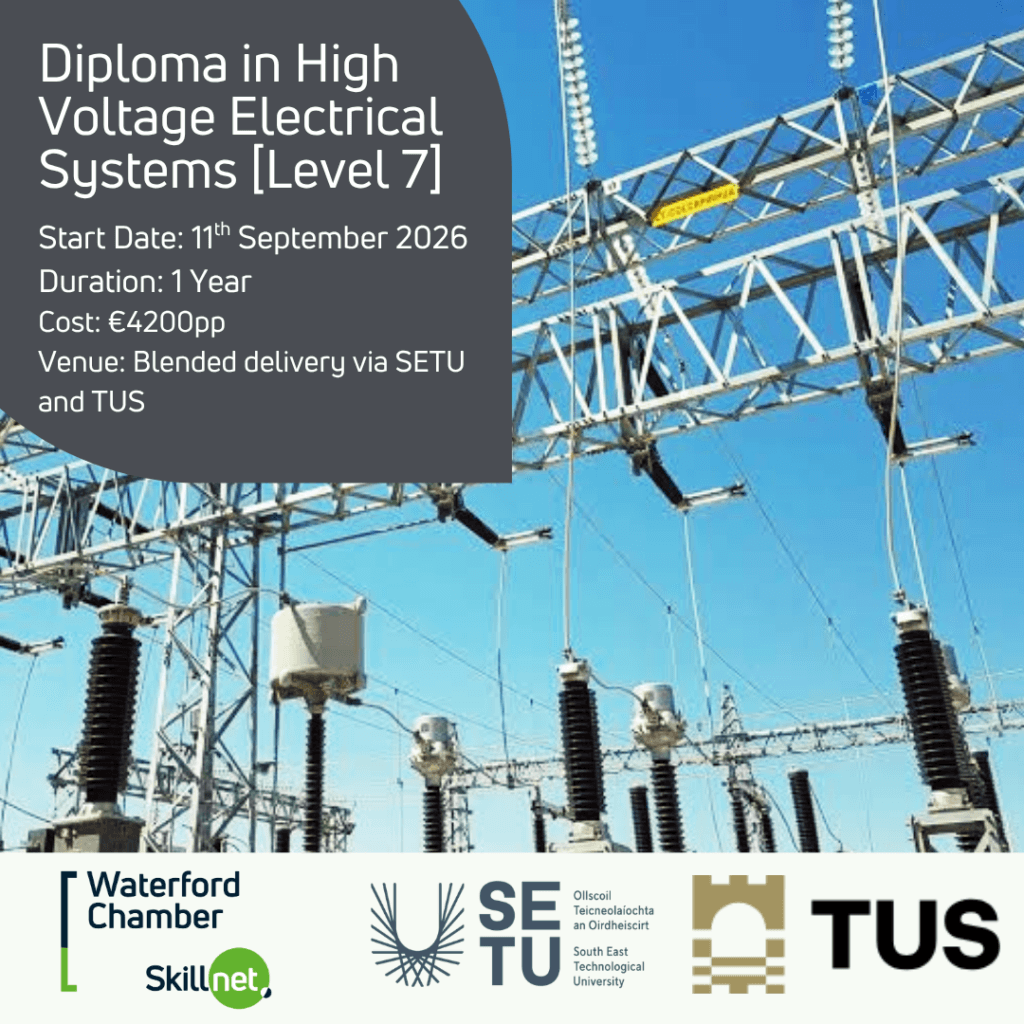
Level 7 Diploma in High Voltage Electrical Systems
September 11, 2026 - June 25, 2027
9:00 am - 5:00 pm
Level 7 Diploma in High Voltage Electrical Systems [SETU / TUS]
IMPORTANT
- The delivery of this programme is subject to demand.
- Cost per person is €4200pp (please note the full fee without Waterford Chamber Skillnet funding is €6000pp).
- Eligible applicants will be invoiced once space is approved.
- The application deadline for this programme is 31st August 2026.
- This programme will start on 11th September 2026 and will be delivered through SETU and TUS.
- Applicants must be employed / self employed in the private sector, or commercial semi-state enterprises to attend this training (full eligibility criteria is listed below).
- Please note that One semester is delivered by SETU and the other by TUS.
About this programme
The Diploma in High Voltage Electrical Systems [60 Credits at Level 7] is designed to upskill electricians and electrical engineers in HV Electrical Systems through a blend of theoretical and practical learning. It aims to develop industry-recognised competence in areas such as High Volt electrical installations, grid connections, substation maintenance and switching facilities – skills which are in urgent demand in Ireland and internationally.
The course is jointly delivered by SETU and TUS in a part-time, blended learning mode over one year. It utilises a work-based model and will have 30% of credits achieved in your place of work. Candidates must be able to complete their work-based learning in a mentored High Voltage environment.
Programme Delivery
This is a part-time blended learning programme that utilises a work-based model similar to apprenticeship programmes. The 60 credits are delivered via technical modules during the academic year with a HV Industrial learning portfolio that runs over the summer months and the semester. The programme is delivered onsite one day per week over two semesters with some online learning each week to support the modules.
****One semester is delivered by SETU and the other by TUS.
Course Content
Technical Modules – Semester 1
- AC Systems Analysis (5 Credits)
Review of Resistance / Reactance /Impedance, Single phase Series / Parallel. AC Power – power factor correction, three phase Star Delta, three phase balanced / unbalanced loads. Fault conditions – calculation of fault currents, short circuit, symmetrical / non symmetrical PU Systems – SLD – simulation of load flow.
- HV Grid Connection & Planning (5 Credits)
Provides an overview of the specification and planning of projects that require connection to the national grid. The key elements of a substation will be reviewed and the common configurations and layout will be covered. Earthing of substations and calculations of step and touch distances will also be covered. Maintenance and safety procedures and the range of technical studies required for the safe design of a substation will also be reviewed.
- High Voltage Power Grid & Infrastructure (5 Credits)
Transmission/Distribution HV /MV/LV systems SLD, Cable/Conductor – selection, testing. HV/MV/LV Infrastructure. DSO/TSO Single market, metering, tariffs. Installations and Connection of Distributed Generators and storage (Wind, PV, Storage)
Technical Modules – Semester 2
- High Voltage Electrical Protection Systems (5 Credits)
Basic Relays – operation and design, timing, specification. Over Current Relays, Intro to Distance / Impedance Relays. Differential Relays. Protection of Transformers. Protection of Bus-bars pilot wire protection.
- HV Transformer Theory and Applications (5 Credits)
Review of Transformer Construction, three phase Transformers, Calculations – Ideal / Non-Ideal. Rating – efficiency, regulation, testing. Vector Group Windings. Instrument Transformers – Voltage and Current Transformers. Oil testing.
- High Voltage Switchgear Engineering (5 Credits)
Switchgear classification, Busbars / Feeders, Disconnectors. Reactors / Surge Arrestors, Fuses Current limiting / Expulsion, Circuit Breakers, Capacitors / Capacitor banks, Insulators.
HV Safety Modules
- High Voltage Safety Compliance (5 Credits) – Semester 1
Review of Electrical Health and Safety Legislation, Regulations in HV Electrical Environments, including I.S. EN 50110 & I.S. EN 61936. Role of Authorised and senior authorised person. Relevant Standards, Directives, Practices and Statutory Bodies. Role of PSDP and PSCS Development of RAMS and safe system of work plans. Safety Clearances relating to HV/MV installations, overhead lines and underground cables –European and Irish legislation. Hazard Zones / Exclusion Zone. Working at heights. Learners to develop risk assessments, method statements for typical work-based tasks, Learners to review employer safety statements and procedures.
- High Voltage Safe Working Systems (5 Credits) – Semester 2
General and Specialist PPE requirement, HV Earthing requirements, Arcing awareness and precautions and protection. Switching Plans, Lock Out / Tag Out, Interlocks. HV Electrical Switching and Safety procedures – Telemess/JSSP, Relevant code of practice. Batteries and Hazardous Environments.
- HV Industrial Portfolio
Of the 60-credit programme, 20 credits are applied to work-based learning in the form of two HV Industrial Portfolio modules, to allow the learner to apply their newly learned technical skills and competence to their work environment. The aim is for the learner to recognise key applications and under the guidance of an industry mentor, apply their learning and solutions to key high voltage applications, which is assessed by a panel.
Entry Requirements
This programme is primarily for upskilling electricians and electrical engineers in the specialist domain of high voltage. It requires a good foundation and experience in the electrical discipline and learners are required to be in a work environment so they can successfully complete the Industrial Portfolio modules, which are 20 credits (1/3rd) of the programme. Hence, entry to the programme has been discussed at length between the academic and industry team and is as follows:
Candidates for this programme must be:
- An electrical employee of a company in the High Voltage sector
AND
- At a minimum, a holder of the following academic and professional qualifications/experience; Advanced Craft Certificate in Electrical (or equivalent) and a minimum of 1 year verified relevant experience in an Industrial Electrical Environment OR Level 7 Ordinary Degree in Engineering in Electrical Engineering (or equivalent) and a minimum of 1 year verified relevant experience in a High Voltage Electrical Environment
- Recognition of prior learning will apply as detailed in the following section.
- Applicants should meet the English language entry requirements established by the Academic Council for this discipline and NFQ programme level.
Cost
- Eligible applicants will be invoiced €4200pp once space is approved.
Eligibility Criteria
Grant funding comes from Skillnet Ireland through the Irish National Training fund, and, as a result, is ONLY available to residents of the Republic of Ireland who work as a sole trader, or for a private or semi-state commercial company registered in ROI.
Key requirements regarding the eligibility of businesses to participate in funding
- Companies must be from private enterprises based in the Republic of Ireland.
- Skillnet Ireland funding is not available to public sector bodies or organisations that are publicly funded such as community-based not-for-profit companies or charities.
- Commercial semi-state companies are eligible providing that income contributed to a Network is not sourced from the public purse.
- Sole traders are eligible as Companies.
Unfortunately the following organisations are not eligible:
- Public sector organisations
- Charity or Not-for-Profit Organisations, and
- Companies based outside the Republic of Ireland
Further Study Opportunities
Graduates from the 60 credit programme will have demonstrated the competence to complete a major programme at level 7. With this award, they can apply for entry onto multiple awards across TUS and SETU in line with specific entry criteria including, for example, the Level 7 – Electrical Engineering Degree with SETU, Year 3 of the B.Eng in Electrical Engineering (TUS)